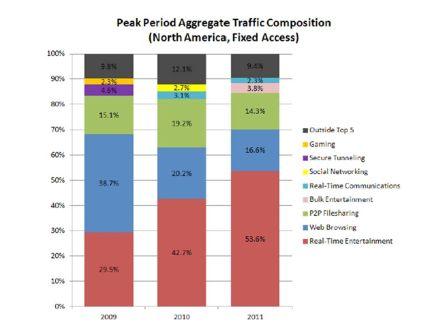
Service provider network planning might be at something of a crossroads, if new data from Sandvine (News - Alert) continue to be seen. Among the bigger potential changes is an apparent leveling of growth in consumer bandwidth demand on fixed networks, with the new problem being the peak evening hours, not overall bandwidth as such.
The flatter consumption profile does not necessarily mean that consumer demand for higher speeds necessarily is satiated. But it probably does suggest that existing application profiles are relatively settled. People have discovered what they want to do, and have settled into a pattern in terms of how much time is allocated to such apps.
And there are some other possible implications. Since much of the growth of demand is real-time entertainment with variable rate settings, adding more capacity does not necessarily help access providers deliver “more” bandwidth, as the new capacity just gets absorbed by current users and applications in the form of “higher-quality” video.
The Sandvine traffic study shows that subscriber usage is becoming increasingly concentrated in a couple of hours in the evening. The fixed network’s peak time has condensed even more than it has been in the past.
While aggregate network traffic was within five percent of its peak value for a duration of 2.5 hours just six months ago, September 2011 saw a peak duration of only two hours. So the peak hours are more concentrated, while overall demand relatively constant.
Within North American fixed networks, real-time entertainment applications are the primary drivers of network capacity requirements, accounting for 60 percent of peak downstream traffic, up from 50 percent in 2010, according to Sandvine.
At the same time, per-subscriber usage remained generally flat overall (mean monthly usage dropped to 22.7 GBytes from 23 GBytes six months ago) and declined on the lower end (median monthly usage dropped to 5.8 GBytes from 7 GBytes), suggesting that subscribers are concentrating the same amount of activity within an increasingly narrow slice of time.
“If this leveling-off of monthly consumption continues, then network operators might be on the cusp of a dramatic shift in how networks are engineered,” says Sandvine.
In a world in which per-subscriber usage is relatively flat from month-to-month, investing to deliver increasing bandwidth no longer makes sense; rather, networks might soon be engineered to deliver a constant quality of experience,” Sandvine says.
The assumption of flat usage is susceptible to unexpected changes in end-user behavior, so few executives likely will declare that the need for faster networks or more capacity is ended. Still, the apparent flattening of demand is a significant development.
It appears that since video is driving much of the demand that rate-adaptive video delivery is starting to have an impact on consumption. Rate-adaptive video represents the majority of video bandwidth, with Netflix alone representing 32.7 percent of peak downstream traffic, a relative increase of more than 10 percent since spring 2011, says Sandvine.
This fact is of particular importance to network operators, since it means that most video traffic adapts to network congestion by shifting to lower bit rates and quality, which both affects the subscriber quality of experience and reduces network demand and congestion.
That also has network engineering implications. When capacity is increased, adaptive video simply apps might simply shift to a higher fidelity level, consuming the new capacity as rapidly as it can be supplied.
Also, the majority of real-time entertainment traffic on North America’s fixed access networks is destined for devices other than a laptop or desktop computer. Game consoles, set-top boxes, smart TVs, tablets, and mobile devices being used within the home now consume 55 percent of all video entertainment traffic.
By volume, 55 percent of real-time entertainment traffic is destined for the television (either directly to a smart TV or using an intermediary like a game console or set-top device), a mobile device or tablet. The remaining 45 percent is being delivered to desktop andlaptop computers.
Like the fixed access network, peak mobile network demand is concentrated in a two-hour band, between 7pm to 9pm. The three largest categories account for more than three quarters of aggregate traffic.
Real-time entertainment generates 30.8 percent of peak demand (of which YouTube (News - Alert) contributes the bulk, at 18.2 percent), continuing a growing trend, while Web browsing is the second largest category, making up 27.3 percent of peak period traffic. Social Networking, at 20 percent, takes the third spot, driven primarily by Facebook (News - Alert).
The overall distribution of consumption on North America’s mobile access networks shows significant disparities, as has been the case for years. The heaviest one percent of upstream and downstream users account for 26.8 percent and 21.3 percent of upstream and downstream bytes, respectively.
The lightest 80 percent of users account for only 10 percent of total traffic.
Mobile operators might face tougher challenges, but not necessarily because of bandwidth demand. As users shift from carrier-provided messaging (short message service or ”text messaging”) to over-the-top messaging, “the stability of the service provider business model” is at risk.
Revenue per bit is the issue. As users shift to over-the-top messaging, they use less SMS. That leads to average revenue per delivered byte declines, as SMS bytes, estimated to be generally $30,000 per GByte, are being replaced by over-the-top bytes that deliver a revenue on the order of $10 per GByte.
Gary Kim (News - Alert) is a contributing editor for TMCnet. To read more of Gary’s articles, please visit his columnist page.
Edited by Rich Steeves

 Internet Telephony Magazine
Click here to read latest issue
Internet Telephony Magazine
Click here to read latest issue CUSTOMER
  Cloud Computing Magazine
Click here to read latest issue
Cloud Computing Magazine
Click here to read latest issue IoT EVOLUTION MAGAZINE


