One interesting behavior of today’s youth is its avoidance of placing and receiving actual phone calls. Instead, young people now share a near mania for texting.
Whenever Yours Truly must communicate with anybody under the age of 25, phone calls are ignored. I have to resort to the not-so-coincidentally ergonomic keyboard on my Samsung (News - Alert).
Since the degree of texting use is a function of one’s age, it makes sense that texting-enabled toys would make their appearance worldwide. Manufacturers could claim that, with all that text and all, they’re actually educational paraphernalia.
You could see it coming, presaged with a spate of patents and patent applications, such as United States Patent Application 20060079147: “A wireless toy phone system that may be used with toy figures, such as dolls. The system may include doll sized phones and child sized phones. The child sized phone may have a display screen and input buttons. A child can compose a message with a phone keypad on the child's phone and send the message to another child sized phone, which will display the message. The phone may also receive messages from other child sized phones. The child may also be able to send a message to a doll sized phone associated with a doll or other figure, and the doll sized phone may respond with lights or sounds or both. The child sized phone may then compose a response that is displayed on the child sized phone simulating a return message from the doll.”
That’s fine, since adult devices such as the T-Mobile (News - Alert) Sidekick LX “Tony Hawk” Limited Edition have a sort of cutesy toy quality about them, despite its $449.99 suggested retail price – though T-Mobile did recently post a Web Exclusive Offer of $199 with no activation fee).
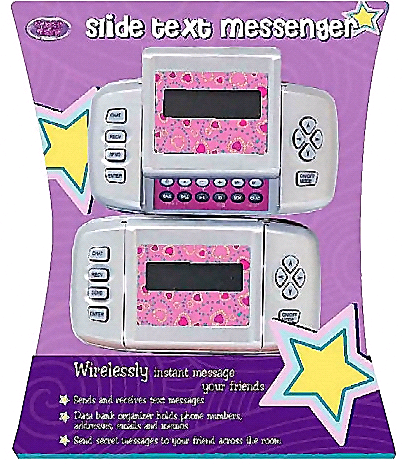
Even $199 is a bit much, especially if your child wants to know why you get to “play” with one and he or she doesn’t. For the kiddies, fortunately, there is the “Slide Click Text Messenger” (shown at right and formerly known as the SMS Messenger), an imitation Sidekick from Sakar International that originally cost $34.95 but can now be purchased online for $19.95. Run as a standalone device, the Slide Click is a bare-bones calculator and data bank organizer that holds phone numbers, addresses, emails and memos.
Buy a second one and you and/or your kids can send wireless instant messages between them, as long as both units are within about 50 feet of each other. It’s a great “fashion accessory” for kids and, best of all, there’s no monthly subscription fee (it’s a “real” toy, remember?).
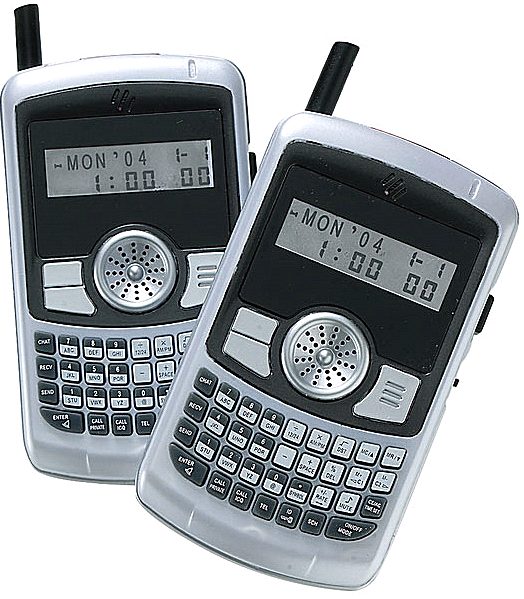
Kids who hunger more for a Blackberry than a Sidekick will swoon for the iChat SMS Text Messenger/Chat Talkies (seen at left and sold on the Web for $44.95). They can both send and receive instant messages and you can even talk between them up a distance of 35 feet. When not chattering or texting, you can use the wireless iChat as an organizer, sort of like a real Blackberry (but more like the competing Slide Click toy). The package comes with two units, in black or silver.
More trendy iPhone (News - Alert) aficionados among America’s youth will probably like the iText SMS Text Messenger with real touch screen technology. Available online for $19.95, it sends and receives text messages. Like its brethren toys, it has a databank organizer which holds phone numbers, addresses, emails and memos. There’s even a secret password function, to keep out parent’s prying eyes, along with a “fully-functioning” calculator (unlike my 1973Texas Instruments SR-10, which is definitely not fully functioning these days).
Here’s what it looks like (note the Barbie-like colorful packaging):
But if you’re lucky enough to get a hold of one (they haven’t been made since 2003), grab a Cybiko handheld computer, perhaps the most sophisticated PDA-type device ever made for teenagers. With over 430 freeware games and applications, it can do radio text messaging over a distance of 300 meters (boosted to 450 meters by running the “UI Power” freeware program) via a QWERTY Keyboard and stylus. An MP3 player was at one time made for it along with a SmartMedia card reader. Devoted Cybiko fans still develop software for it and continue to chat with each other in Cibiko wireless chatrooms.
There were two basic model categories: The Cybiko Classic and the Cybiko Xtreme, shown below. The Classic came in five colors (blue, purple, a yellowish neon green, white and the rare black model with yellow keys. The Cybiko Xtreme, a second generation device, had a faster processor (18 MHz Hitachi H89S/2323 and an 4 MHz Atmel (News - Alert) AT90S2313 coprocessor to handle the radio interface), more RAM ROM, a new operating system, a new keyboard layout and case design, greater wireless range, a microphone, improved audio output, and smaller size. It came with 515 KB ROM flash memory and 1.5 MB RAM, as well as an add-on slot in the back for the MP3 player.
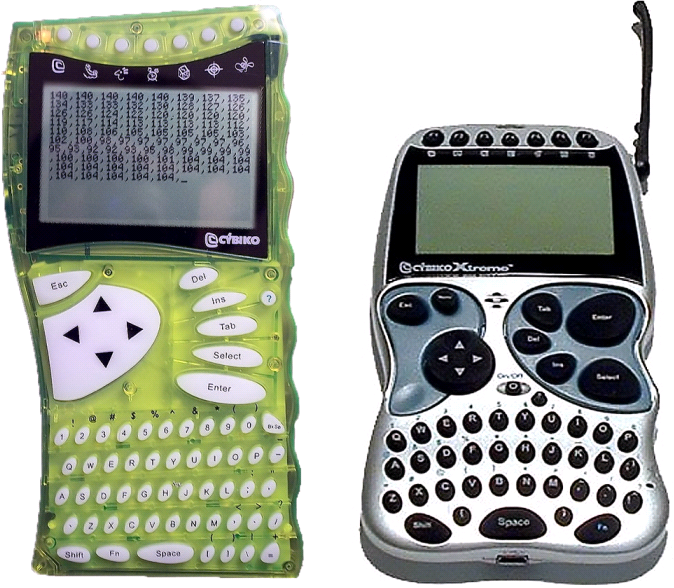
The Cybiko Xtreme retailed for $89.99 to $139.99, and came with PC software compatible with Windows 98, 2000 and ME. It also came with a USB cable, two NiMH rechargeable batteries, and a power supply. Aside from the IM/chat/email functions, you could also play games, watch “video", and record dates and keep track of tasks with a journal and date book. There was also calculator, translator, and text programs.
Developers can write software for the remaining examples Cybiko, which can be programmed in either C, or CyBasic, a version of the BASIC programming language modified with Cybiko-specific extensions.
Today, aside from dedicated user groups and hobbyists, there is no support for the Cybiko. But it did point today to a new generation of telecom-related toys.
Don’t forget to check out TMCnet’s White Paper Library, which provides a selection of in-depth information on relevant topics affecting the IP Communications industry. The library offers white papers, case studies and other documents which are free to registered users.
Richard Grigonis is Executive Editor of TMC (News - Alert)’s IP Communications Group. To read more of Richard’s articles, please visit his columnist page.
Edited by Michael Dinan

 Internet Telephony Magazine
Click here to read latest issue
Internet Telephony Magazine
Click here to read latest issue CUSTOMER
  Cloud Computing Magazine
Click here to read latest issue
Cloud Computing Magazine
Click here to read latest issue IoT EVOLUTION MAGAZINE


