It's a reasonable question, in the abstract, to ponder the matter of U.S. wireless service spectrum requirements, and to ask the question of whether some of the currently-allocated spectrum is being used in the "best" way. Of course, "best" is a matter of opinion. Spectrum (News - Alert) is the foundation for many industries, ranging from local radio, local broadcast TV, paging, mobile phone service, microwave backhaul, satellite networks. Spectrum also is used by government, military, utility and public safety communities as well. So "best" is a value judgment conditioned by place in a business ecosystem that uses spectrum.
Some question whether AT&T (News  - Alert), for example, is simply hoarding spectrum it has purchased, the implication being that the company simply is squatting on spectrum to deny its use to competitors. That would not be an unimaginable scenario, of course. But most spectrum these days is fairly expensive to acquire, especially at frequency ranges that make it highly useful for mobile communications of the sort people associate with mobile phones and related devices.
It would be a difficult proposition for a public company to invest heavily (say billions of dollars) in an asset that is not going to be used to create a revenue stream that justifies the investment. Indeed, it is a reasonable question to wonder what AT&T might be wanting to do with its newly-acquired spectrum.
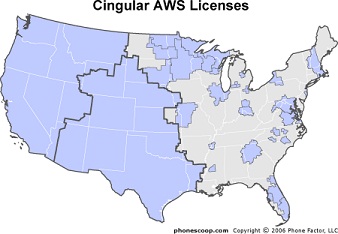
In fairness, the AWS spectrum AT&T is accused of hoarding had some issues. In fact, one contemporary report said "Cingular (News - Alert) (the AT&T brand name at the time) bought a wide variety of different licenses. There's no one clear strategy or pattern to their purchases."
The spectrum pattern clearly has some issues. The spectrum blocks are not commensurate across the country, for example. AT&T won two major 10 MHz licenses covering the whole Western United Statesand Central United States. AT&T also purchased 20 MHz worth of spectrum in Los Angeles and Dallas.
AT&T also won a smattering of licenses in the rest of the country. The largest metro areas covered in that group are Boston, Washington/Baltimore, Miami, Atlanta, and Chicago. All of those were 10 MHz C block licenses. In smaller cities, they went for the larger 20 MHz licenses.
So a clear problem is that, as a national carrier, AT&T needs spectrum that is consistent across its service footprint. That's a marketing problem of some scope. A national carrier obviously would like to be able to advertise service of certain minimum specifications no matter where a customer might be using service. Consistent capacity across the footprint helps, in that regard. And no matter what else one might say about the AT&T AWS spectrum, it was not consistent.
It is one thing to reinforce capacity in heavy-demand areas; it is another to ensure a minimum level of capacity across the whole footprint. Ironically, in some ways, the AWS spectrum that AT&T is accused of hoarding will be used to launch the new Long Term Evolution network.
Need for additional spectrum, in adjacent frequencies, was one reason why AT&T recently bought spectrum from Qualcomm.
The move was described as part of AT&T’s construction of a new 4G mobile broadband network. The spectrum covers more than 300 million people total nationwide: 12 MHz of Lower 700 MHz D and E block spectrum covers more than 70 million people in five of the top 15 U.S. metropolitan areas — New York, Boston, Philadelphia, Los Angeles and San Francisco; 6 MHz of Lower 700 MHz D block spectrum covers more than 230 million people across the rest of the U.S.
But spectrum alone is not the answer to the question of why newly-acquired spectrum has been put to work. There are business considerations. AT&T also had made a decision to upgrade its 3G network to HSPA+, which provides bandwidth comparable to other 4G networks. In a direct sense, AT&T did not "need" to immediately activate a 4G network at the same time as it was activating a higher-speed network that would function as a "4G" network. In fact, T-Mobile (News - Alert) USA now has activated its own HSPA+ network, and is marketing it as "4G," with the belated blessing of the International Telecommunications Union.
For financial reasons and human resource reasons alone, AT&T might not have wanted to "immediately" build and launch both 4G and advanced 3G (otherwise "4G" in terms of performance) networks at the same time. But to say AT&T is "hoarding" spectrum seems unjustified. See for more discussion.
AT&T will deploy its new LTE network in 2011, on 700 MHz and Advanced Wireless Services (AWS) spectrum. Hoarding? Hardly.
Gary Kim (News - Alert) is a contributing editor for TMCnet. To read more of Gary’s articles, please visit his columnist page.
Edited by Jaclyn Allard

 Internet Telephony Magazine
Click here to read latest issue
Internet Telephony Magazine
Click here to read latest issue CUSTOMER
  Cloud Computing Magazine
Click here to read latest issue
Cloud Computing Magazine
Click here to read latest issue IoT EVOLUTION MAGAZINE


